Thursday, June 30, 2011

LOW COST TRIPS AROUND BRUSSELS: KASTEEL VAN GAASBEEK

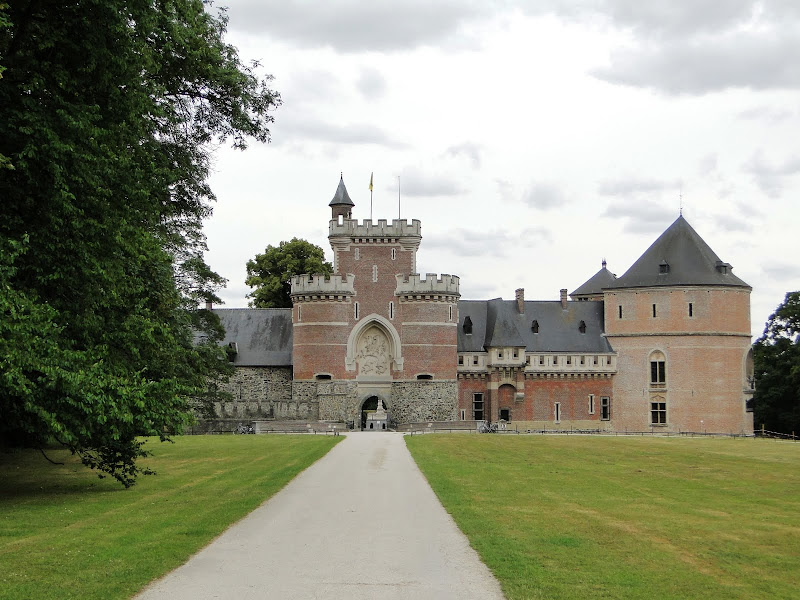
Kasteel van Gaasbeek
Here's some basic Flemish for you: Kasteel means castle. Gaas stands for gauze, while beek means brook. To this we add the common-knowledge fact that van is the same as of, and we arrive at a perfect translation of the whole name. Yes, my friends, Kasteel van Gaasbeek is no more than the Castle of Gauze Brook, and who needs Dutch classes anyway if such excellent toponym translations are available with just some good will and a bit of google. There we went a few weeks ago - to the Castle of Gauze Brook, formerly home to one weird lady, today a real door to the past, which miraculously made us look under 26, so that we could pay the reduced fee.
Destination: Kasteel van Gaasbeek
Transport: DeLijn bus 142 from Midi to the Gaasbeek stop.
Equipment: picnic, walking shoes and a camera.
Cost: DeLijn ticket (1,50 € one way) plus 7 € entrance fee (unless you are - or look - under 26, then: 5€).
The bus conveniently stops right next to the castle park entrance which, in case you still have doubts in spite of its grandeur, is clearly marked with enormous signs informing that you have indeed reached Gaasbeek. The park is huge, very beautiful, and features several lakes, lanes, paths, bits of forest, meadows and lawns - perfect for any outdoor activity from hiking to biking to picnicking.
Any way you go, you will eventually arrive at the castle itself, which, placed on a hill, towers over the park and its lakes. Now the tricky part: do your best to look under 26 and the nice ticket lady will give you a cheaper ticket even if you admit that your real age is 27, while for some people even 33 (I'm sure some people won't mind this indiscretion). For the price of 5 € you are handed an audioguide and off you go... to the garden, where you await a human guide as well.
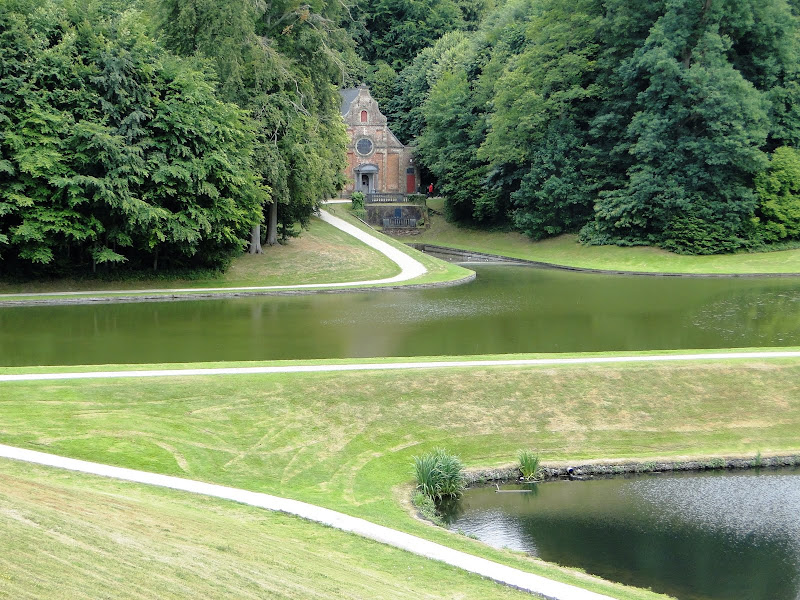
Gaasbeek park
The two guides complement each other - human giving you the number in three to four languages, audio chirping into your ear in your language of choice. Effect: human guide smiles with appreciation when human non-guides in unison and complete silence turn to a painting or piece of furniture described by the audioguide whispering in their ears. Human guide then answers non-guides' questions, while the audioguide patiently waits until a new number is announced by its human counterpart. In this happy way you take a tour around the castle and you find out that:
  • the castle's last owner, Marquise Marie Arconati Visconti, was a very strange lady;
  • the castle's last owner, Marquise Marie Arconati Visconti, liked dressing as a boy in her 60s.;
  • the castle's last owner, Marquise Marie Arconati Visconti, constructed several secret passages and hiding places, so that she could a) meet her lovers and b) spy on the other people in her household;
  • the castle's last owner, Marquise Marie Arconati Visconti, had a relative who liked dressing as a Turkish prince (or something to that effect);
  • in the middle ages people washed twice a year - a general remark which caused a lot of giggling;
  • people used to sleep in a sitting position, as lying was reserved for the dead;
  • XV-century toilets looked like thrones.
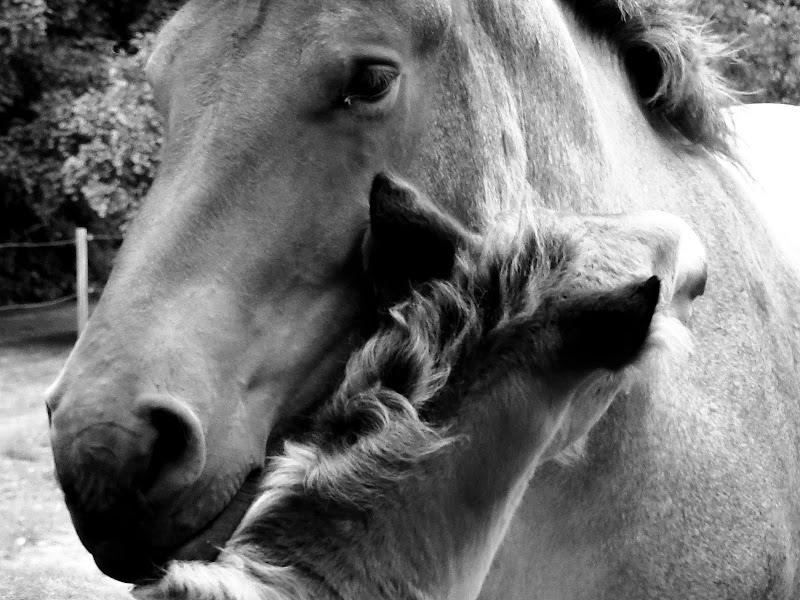
Horses in Groenenberg
Enriched by this knowledge, you proceed with your visit. Upon appointment and having paid an extra fee, you can also take a stroll in the French garden, which is still kept in a traditional, XVI-century way and thus very fragile. Apparently, very beautiful, too. Appointment-less, however, we explored the park instead, and found a picturesque chapel, as well as - wait for it - a "Pavilion of Pleasure", whose purpose, sadly, remains unexplained.

If all this is still not enough for you, leave the premises, cross the street and wander off to Groenenberg, another huge garden (although a bit less well-kept), full of old trees (including three sequoias) and horses. In addition, it is nearly deserted, and will be perfect if what you're looking for is a secluded spot. 

All in all, an excellent trip within 30 minutes from Brussels, perfectly doable once you've dedicated three to four days figuring out your itinerary on the DeLijn page, which might just be the least user-friendly website ever created. Apart from that - Gauze Brook rules!

Saturday, June 25, 2011

BIG, BIGGER, EU

The European Parliament
I think that the best way to start writing again is to just pick up exactly where you left, no excuses, no explanations. What excuses could I give, anyway? That my life has become a kaleidoscope of changes, that I keep bumping my head on the bunk bed, that I'm constantly taking decisions I'm not sure I want to take? No, no excuses. Instead, let me tell you about heart of the heart of Europe: the European Quarter in Brussels. 

Big, Bigger, EU
The very centre of the European district is the Schuman roundabout. You can get there straight from the airport, and from every part of the city by train, bus and, of course, the tube. The underground station is by all means the ugliest one in Brussels (believe it or not, they tend to be quite pretty), which does not cease to amaze me, as this is the very station that receives all the VIPs. The Commission and Council are right there, their huge buildings waiting to impress and intimidate you as soon as you leave the underground. Fancy men and women, speaking every language you can possibly imagine, move around quickly, expertly, sporting their suits and dresses, never taking off their badges. They have quick coffees and croissants, and disappear behind the big doors of important buildings, inaccessible for regular, badgeless, mortal individuals like yours truly. It's big, it's bigger, it's EU.

Ghost town
The European district in the morning is absolutely bustling with life. The crowded underground spits out thousands of people (the Commission alone employs 25 thousand!), who hurry in all directions, chat animatedly, stop for a quick breakfast at one of the many cafes... All in all, your typical morning in the busy city centre. Go to the very same places after 6 pm or on a day when the Commission in closed, and you will be shocked at how the hustle and bustle of this neighbourhood gives way to something completely opposite - the streets seem abandoned, the cafes and restaurants don't even bother opening, all is calm, all is quiet... Strange, cold and unsympathetic. The big buildings tower over this ghost town, patiently waiting for the holiday to end.

Go green!
Le Cinquantenaire
Contrary to what you might be imagining by now, this area is not ugly. There are many beautiful old buildings which have been adapted for offices, and if you feel like a stroll after work, you are very close to two lovely parks: Parc Leopold and the famous Cinquantenaire. They are both worth a stroll, and they both boast more than just trees and grass. Parc Leopold is home to the Museum of Natural History, while Cinquantenaire hosts the Autoworld (car museum) and the Royal Museum for Art and History. You can also go up the Triumphal Arch (built by king Leopold II for the fiftieth anniversary of the creation of Belgium - hence the name of the arch and the park) and enjoy very nice views of Brussels. I personally like having lunch in the park - a very nice change from the monotony of the office.

Night life or Networking?
Although basically everything in close vicinity of the Commission closes around 6 pm, you can also go out in the European district. In order to do this, however, you must take a walk towards the Parliament and visit the famous Place Luxembourg or, for the ones in the know, Place Lux. The many bars there (including a shabby Polish one) open their doors to all kinds of Eurocrats, ranging from the very bottom of the food chain (les stagaires or interns) to prominent officials. Place Lux is the place every Thursday, and it is also considered a good place to meet the right people and work on your career. So if you're in need of some good nightworking, I mean, networking, make sure you pass by.

Apparently, the city of Brussels now insists on animating the European district. People are invited to buy flats in the area, shops are encouraged to open, new European buildings are being placed in different parts of the city - all in all, Brussels is trying to change this strange European ghetto into a normal neighbourhood. As I get out of the underground at Schuman every morning, I tend to think that they are still very far from it. But that's okay. This way, I have a story to tell.

Monday, May 30, 2011

LOW COST TRIPS AROUND BRUSSELS: LA MAISON D'ERASME

The Erasmus House in Anderlecht
You open your eyes. It's a sunny Saturday morning in Brussels. You feel like going for a walk. The old town? Oh my, the tourist crowd is unbearable at the weekends (Why is Manneken Pis so small? Why do they make me choose between a Brussels waffle and a Liege waffle when all I want is a decent Belgian waffle? Where do I buy the best French fries?). A park? Yes, nice, but you've been to all of them already, haven't you? Ardennes? Too far away. Walk around your neighbourhood? Too close. And then an illumination: why not the Maison d'Erasme (House of Erasmus) - a museum and park/picnic spot combined?
Destination: La Maison d'Erasme.
Transport: bus 49 or underground 5, get off at Saint Guidon stop.
Equipement: walking shoes, change for coffee and a camera.
Cost: public transport ticket plus 1,25 Euro entrance fee.
Yes, you're right, there is a bus stop right next to Maison d'Erasme, which saves you a few minutes walking from Saint Guidon. But these few minutes are very much worth devoting to a nice stroll through the most beautiful part of Anderlecht, a usually frowned-upon and not very touristy neighbourhood.

The Beguine convent
So make sure you take a good look at the pretty Place de la Vaillance and its century-old houses. I recommend a coffee on one of the terraces - just sit down and take in the view of the majestic Saint Guidon church. The church itself is only a few steps from the old Beguine convent (Beguinage), built in the XIII century and serving its original purpose for five centuries. A very welcoming ticket lady will tell you all about the Beguines and their habits: apparently, they were women who were widowed, unmarried or whose husbands were doing their duty and dying in a war somewhere; they would live together for protection and peace, in a semi-religious order (but they could leave whenever they wanted), providing the local community with small services, such as taking care of the sick. Their two houses are now available for tourists and host a splendid exhibition of... stuff. From a bicycle to child's high chair to tiny furniture made from feathers - you will find lots of XVIII and XIX century things that belonged to the people of Anderlecht. However, apart from the chairs in the little chapel, no original Beguine belongings have survived to this day. Oh, and you get in on the same ticket you buy for the Maison d'Erasme.

The latter is within a two-minute stroll from the Beguinage. Surrounded by a high wall, it is a XV century house, which was built to accommodate the church's most prominent guests. One of those - for the period of five full months - was Erasmus from Rotterdam. Apparently, if you're famous enough, they will name a house after you even though you only spent a few months there. The museum inside is sort of a tribute to Erasmus and his work, with an impressive collection of first editions of his books, many interesting paintings and a disturbingly large cartoon-like figure of the man himself in the hall. 

The garden
But the real treat is the garden or rather - the two gardens (entrance is free, by the way). The first one plays with the idea that the great Erasmus was a bit of a hypochondriac. It thus contains all the possible curative plants that could've helped the poor man to cure all his supposed ailments. Each plant is accompanied by a little figure of Erasmus, on which the affected body part is indicated. The benefit of the visit is thus triple: you learn about the man's brilliance but also about his weaknesses and, finally, you get to know the plants!
The other garden is lovely, if a bit small. The original benches beg for a photo, and so do the Latin phrases, surrounded by water and translated into three languages. This part of the garden is called philosophical, and, I must say, it does inspire silent contemplation (ours was limited to What are we doing for lunch? but at a different time of day something more philosophical might enter your head in view of both the scenery and history). 

Sounds interesting? What are you waiting for then? Go and enjoy your Saturday morning at the House of Erasmus!

For more pictures go here.

Tuesday, May 17, 2011

MOOD FOR MOROCCO

Moroccan pastries
Having discovered Africa, I thought few things in my life would be nearly as exotic as that, especially in a place like Brussels. How different can Belgium be from Poland? And even though I'm still not sure about Belgium, I already know that there is something amazingly new in stock for me in Brussels. For here I am, in the heart of Europe, getting to know the ways of... Morocco. Strange? Not if you think that 20% of people in Brussels come straight from Morocco or were born into a family of Moroccan immigrants. And so, I give you my Subjective Quick Guide to Moroccan Pleasures. Enjoy!

Tea - the ultimate drink
Throughout my life, I have drunk a lot of tea. But there is nothing, nothing like Moroccan mint tea. Of course, alcohol being off limits, it's not surprising that something tasty to replace it be invented. However, Moroccan tea is not the next best thing - it's better! It's very simple to prepare: green tea, fresh mint and a generous amount of sugar. It goes with everything from breakfast till dinner, it can even act as a refreshing beverage on a hiking trip. Only drawback - calories. Frankly, I've stopped caring. Note: the tea is best when drank in a Moroccan tea room. Be careful, however, as women typically stay away from such places, and even though this rule does not apply to Western women, it's always better to come with your man. Sexist as it may seem, it might save you very curious (not to say "hostile") looks from the usual tea room crowd, consisting of middle-aged men in long frocks.

La crèpe marrocaine - as good as it gets
Moroccan pancakes
I have already mentioned in one of my previous entries that the famous Marché du Midi has introduced us to one of the world's perfect dishes: the Moroccan pancake. It is not a typical pancake (the dough is not sweet) but what they call semen (really, no pun intended!). It is made right in the middle of the market, behind a big olives stand. Just localise the stand and take your place in the long queue (don't get discouraged, it will advance very quickly). I always ask for the simple combination of honey and Moroccan cottage cheese, which really is something to look forward to at the end of the week (Marché du Midi springs to life only once a week: on Sundays). But you can put anything in your pancake - from olives to pickled artichokes to dried tomatoes, together with the omnipresent cheese and honey. So good!

Moroccan pastries - the word is "yummy!"
Have you ever entered a Moroccan bakery? I bet you couldn't take your eyes off the colourful, artistically shaped pastries, whose main ingredients include such delicacies as almonds, pistachios, hazelnuts and dried fruit. Each bakery typically offers several types of such cakes, and displays them proudly in their window, in neat stacks, which somehow look absolutely irresistible. Again, full of calories, which maybe explains why so many Moroccan women are plump under their loose frocks... But who cares! As far as I'm concerned, keep the pastries coming!

Molenbeek
Markets - live from Morocco
 We have recently stumbled upon yet another market (Brussels is virtually full of them). If we had thought that Marché du Midi was full of Moroccan people, crowded and noisy, our new discovery proved us wrong. Once you get used to the familiar hustle and bustle of Midi, make sure to visit Molenbeek. Just walk towards the canal from the central Bourse area, and watch the shopping windows change along the way. Posh clothes shops become cheap kebab restaurants, elegant drink bars turn into buy one get one for free shops. Europeans disappear from the busy streets. This is the neighbourhood of women dressed in African pagne, women in veils, a quartier of different standards. Cross the canal and enter the huge market, a buzzing street, where you can buy Moroccan clothes and fabrics, tea pots and about anything you might need. Hungry? No problem: all along the market street thare are several stands with grilled meat and fish, accompanied by tea and sweets. Working language: Arabic. Of course, people might stare. But so what - that's the closest I've been to Africa in months!

And there is only one problem. Now I simply must go Morocco!

Sunday, May 15, 2011

BLOG WRITER'S BLOCK

Yes, I know, I have neglected my blog. For the first time in two years I have stopped writing regularly. The blog, the Polish website about Africa where I'd been submitting articles, e-mails, so many e-mails I have yet to answer... Truth be told, it doesn't feel good. I have come to like sorting my life into short pieces, making sure nothing is going to disappear, nothing will be forgotten. Turns out I need it. And so I have come to my senses.

The reasons for my self-imposed silence were many. I started working over a month ago, and, among other things, I have learned that not being a teacher requires spending a large part of your day in an office. Enjoy it as I might, not much time is left for living during the week. I am an intern now, which, apart from constantly making me wonder if I'm too old for that, allows me to take a - I must say secure and pleasant - plunge into the ocean of the Brussels work market. The competition is fierce. The pays are low. What else could I ask for?

Secondly, I might have been a bit down lately. Things have yet to take the right course for us, and it's not always easy to stay positive when you start making comparisons which you'd probably better avoid. Sitting in our rented room, I let my mind drift off to our Gabonese terrace, where we would stand for hours, staring at the sunset. How come you only remember the great times? Why can't I see our stay in Africa rationally? Why is it suddenly Paradise Lost? And do I have to be this dramatic? I know the beginnings in Gabon were very difficult and that, exactly as I do now, I spent a lot of time sighing the deep sigh of goodness-me-am-I-in-a-pickle-now! But I seriously can't remember this. And so I don't let myself think about Africa too much.

Finally, probably as a result of the previous two reasons, I have lately been suffering from a kind of blog writer's block. I wanted to write but it just wouldn't come out. Consequently, a patient girl that I am, I gave up trying altogether after about a week. Until the big breakthrough - last week, all of a sudden, I produced a new article in Polish. Yesterday I answered several e-mails (don't worry, yours is surely on its way). I'm back. Live from Brussels, especially for you. Stay tuned.